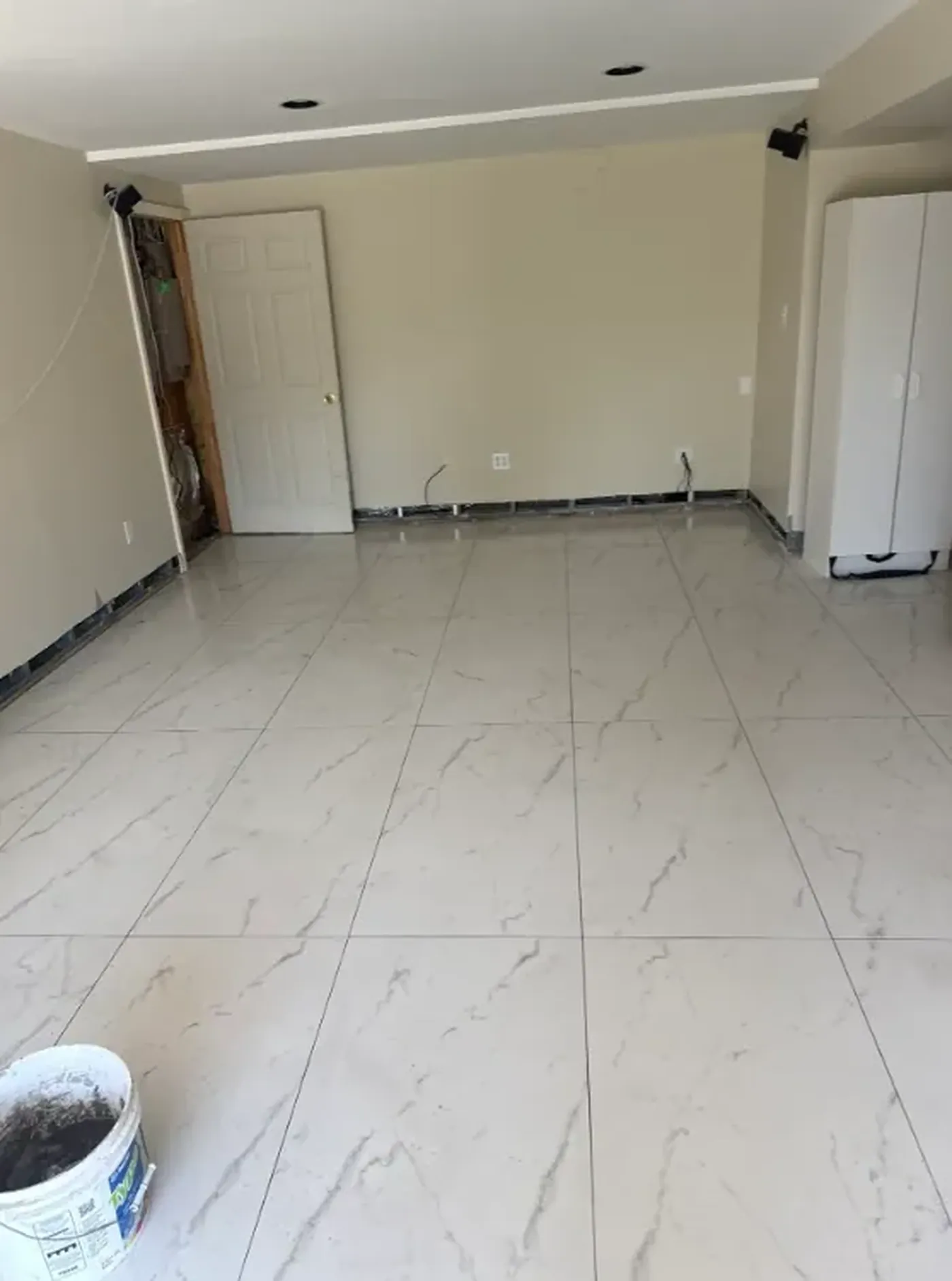
Tile removal & floor prep
in Chicago, IL
We take up old tile, mortar and underlayment and get the floor ready for new tile.
Tile removal and floor prep
Old tile can be stuck to cement board, a thick mortar bed, concrete, plywood, or a stack of floors laid on top of each other over the years. Each one comes up differently. We work around your cabinets, thresholds, trim and plumbing, and decide with you what comes out and what can stay.
Once the floor is bare, we look for cracks, loose panels, moisture and soft spots. We seal off the work area with plastic and clean up at the end of every day. If old tile, black mastic or sheet flooring might contain asbestos, we stop and ask you to have it tested before we disturb it.
What to look for in a tile floor

Four things worth checking on any tile floor, shown on one of our kitchens.
Joint layout
The grout lines run square to the island. We snap a reference line before setting, so the cut pieces come out even on both walls instead of leaving a thin sliver at the last row.
Perimeter gap
The tile stops short of the wall, and the baseboard covers the gap. A floor this size moves with temperature and humidity, and that gap keeps it from cracking or tenting.
Floor register
We plan the layout so a vent lands inside one tile or on a joint. Cutting it across four tile corners looks messy and weakens the edges.
Veining
We open several boxes and lay tiles out dry before setting. That way the darker veins spread across the room instead of bunching up in one corner.
How a project works
Protect and contain
Before we start, we talk through access, furniture, appliances and where the debris goes. We cover the floors along our path, seal doorways with plastic, and set up a fan to pull dust out of the room.
What you’ll do
Move furniture and small items out of the room, and tell us if there's floor heat.
What we’ll do
Cover the path, hang dust barriers and arrange the haul-away.
Remove the existing floor
We take up the tile, mortar, adhesive and any loose underlayment. Thinset tile on concrete comes up differently from a mortar bed over wood, so we pick the tools for the floor in front of us.
What you’ll do
Keep kids and pets away from the room while we're taking the floor up.
What we’ll do
Remove the old floor down to a solid base and clear out the debris.
Assess the substrate
With the floor bare, we check for cracks, signs of moisture, soft spots, rotted wood and height changes. Then we put a straightedge on it and measure how flat it is against what your new tile needs.
What you’ll do
Look over what we found with us and decide on any repairs.
What we’ll do
Show you any damage and price repairs before doing them.
Repair and prepare
Prep can mean screwing down or replacing underlayment, patching, treating cracks, grinding high spots or pouring self-leveler. Large porcelain tiles need the flattest floor, so they usually need the most prep.
What you’ll do
Approve the prep plan and the start date for the new floor.
What we’ll do
Repair the subfloor and level it to suit your tile.
Confirm the ready surface
We leave the floor clean, solid and flat, ready for your new tile. If a patch or leveler still needs to cure, we tell you when the floor can be tiled.
What you’ll do
Keep the prepared floor dry and clear until the tile goes down.
What we’ll do
Give you a ready date, or start setting tile if we're doing that too.
Materials & surfaces we work with
Ceramic
Ceramic is forgiving to install, but small tiles with slightly uneven edges still need a flat floor to look straight. We plan the prep around the tile you've picked and the room it's going in.
Porcelain
Porcelain is dense and strong, but it won't hide a bad floor. We prep for the tile's actual size and the mortar coverage it needs.
Large-format porcelain
Large tiles show every dip and hump, so they need the flattest floor of any tile. We check the flatness spec for your tile and level until the floor meets it, so each tile sits fully in mortar with no hollow spots.
Natural stone
Stone needs a stiffer floor than porcelain, and some types crack if the floor flexes even a little. Before stone goes down, we check how much the floor bounces and whether any moisture is coming up through it.
Mosaic
Mosaics can follow a sloped or uneven floor, but the sheets still need a smooth base with no sudden dips or humps. We pay most attention at drains and thresholds, where the floor changes height.
Glass
You can see through glass tile to the mortar and floor behind it, so the base has to be clean and even. We scrape off old adhesive and smooth out patch marks that could show through.
Your tile's box or spec sheet says how flat the floor has to be. We prep to that number.
Prep in older and newer homes
Many homes around Chicago, from bungalows and two-flats to houses with later additions, have floors laid at different times. That can mean several layers of old flooring, doorways at different heights, or a step where the old house meets the addition. When we take those layers up, we plan the new floor height so it lines up with the rooms next to it. In a kitchen we also watch the cabinet line and make sure the dishwasher and fridge still fit. If there's floor heat, we find the cable or tubing before we cut or drill anywhere near it.
Removal in a business
In a store or office, removal often has to fit around deliveries, a neighbor's open hours, and a safe path for staff. Jackhammers and grinders are loud, so we agree up front on working hours, how far dust can travel, and where materials sit. We also agree on when the floor is handed to the next trade. The timing depends on what we find under the old floor and how long any patch or leveler takes to cure.
Protect the prepared floor
Keep a prepared floor clean and dry. Don't set furniture on it, wash it, or cover it with plastic that traps moisture while a patch or leveler is curing. If you have to walk across it, stay on the protection we leave down.
Once the new tile is in, use a cleaner made for your tile and grout. At entries and storefronts, sweep up winter salt and grit often so it doesn't wear down the surface.
What affects the price
What shapes the scope?
Tick what applies to your floor. We give you a price after we've seen it.
Removal and prep pricing depends on how many layers are coming up, how easy the room is to get to, disposal, the condition of the subfloor and the size of the room. One layer of tile over plywood is a much smaller job than a thick mortar bed or a floor with rotted underlayment. Our quote lists the work your floor needs, room by room.
We can't see everything until the old floor is up. If we find damage, we show you and price the repair before doing any extra work. Call us or send a few photos to set up a visit.
Where we work
Can you remove tile without removing the cabinets?
Usually, yes. It depends on how the tile meets the cabinets, the toe-kick height and how thick the new floor will be. We look at the edges and tell you where we'll cut by hand, pull trim or add a transition.
How do you control dust during tile removal?
We seal off the room with plastic, cover the floors on the way in, run a fan to pull dust outside and clean up every day. Tile removal always makes some dust, and we keep it in the work area. If old material might contain asbestos, we stop and have it tested first.
Does the floor need to be perfectly level?
No. Tile needs a floor that's flat and solid, which isn't the same thing as level. A floor can slope a little and still be flat, or be level overall with dips in it. We measure flatness against what your tile needs and prep to that.
Can old tile stay in place under new tile?
Sometimes, if the old tile is solid, well bonded, clean and flat. If it's loose, cracked, damp or hollow-sounding, it comes out. We check your floor before deciding either way.
What if the old adhesive could contain asbestos?
Don't sand, grind or scrape it. Have a licensed asbestos inspector test it and tell you how it should be handled. We start removal once the results are in and any required abatement is done.
How long before the new tile can go down?
It depends on the repairs, the leveler and any membrane. A thin patch can be ready in a few hours, while a thick pour of self-leveler can take a day or more. We give you a ready date once the floor is prepped.

Planning a tile project?
Call us or send a few details. You don’t need measurements yet.